


Introduction to Faradion Reliance
Faradion Reliance refers to the strategic acquisition of Faradion Limited, a UK-based battery technology company, by Reliance New Energy Solar Limited, a wholly owned subsidiary of Reliance Industries Limited. This acquisition marks a major milestone in Reliance’s long-term clean energy strategy and reflects its commitment to sustainable and future-ready technologies.
Faradion is globally known for pioneering sodium-ion battery technology, which is emerging as a strong alternative to traditional lithium-ion batteries. Through this acquisition, Reliance aims to make energy storage safer, more affordable, and more accessible, especially for large-scale renewable energy projects in India and beyond.
This partnership goes beyond a financial deal. It represents a technology-focused collaboration designed to support the global transition toward cleaner energy systems.
What Is Faradion Reliance?
Faradion Reliance is not a separate product or brand name. Instead, it is a commonly used term that describes Faradion Limited operating under the ownership and strategic leadership of Reliance Industries.
Reliance completed the acquisition to strengthen its position in advanced battery technologies. The goal is to secure intellectual property, reduce dependence on lithium supply chains, and develop large-scale energy storage solutions that support electric mobility and renewable energy adoption. Under Reliance’s ecosystem, Faradion’s technology is expected to be scaled through gigafactories and integrated into clean energy infrastructure, particularly in India.
About Faradion Limited
Faradion Limited was founded in the United Kingdom in 2011 with a clear mission: to develop commercially viable sodium-ion battery systems. From its early days, the company focused on solving the limitations of lithium-based batteries by using more abundant and sustainable materials.
Over more than a decade of research and development, Faradion refined its battery chemistry, safety standards, and performance capabilities. Unlike many experimental battery startups, Faradion successfully transitioned its technology from laboratory research to real-world industrial applications.
The company gained international recognition because it addressed key concerns such as high costs, safety risks, limited raw materials, and environmental impact associated with lithium-ion batteries.
| Field | Details |
|---|---|
| Name | Faradion Reliance |
| Founded | 2011 (Faradion Limited) |
| Headquarters | United Kingdom |
| Owned By | Reliance New Energy (Reliance Industries Limited) |
| Industry | Battery Technology |
| Core Technology | Sodium-Ion Batteries |
| Focus Area | Clean Energy & Energy Storage |
| Net Worth | Estimated acquisition value around £100 million |
| Founder | Faradion Engineering Team (UK) |
| Parent Group | Reliance Industries Limited |
| Physical Appearance | Not applicable (Corporate Entity) |
| Family | Part of Reliance Corporate Group |
| Official Website | faradion.co.uk |
| Social Media | Active on LinkedIn |
Reliance Industries and the Clean Energy Vision
Reliance Industries Limited, led by Mukesh Ambani, is one of India’s largest and most influential multinational conglomerates. In recent years, Reliance has announced ambitious plans to achieve net-zero carbon emissions, investing heavily in clean and renewable energy solutions.
The acquisition of Faradion aligns perfectly with this vision. Reliance is building an integrated green energy ecosystem that includes solar manufacturing, green hydrogen, energy storage systems, and electric mobility. Faradion’s sodium-ion technology gives Reliance a strategic advantage by offering a reliable alternative to lithium-based batteries without heavy dependence on imported resources.
Understanding Sodium-Ion Battery Technology
Sodium-ion batteries operate on principles similar to lithium-ion batteries, but instead of lithium, they use sodium ions to store and release energy. Sodium is one of the most abundant elements on Earth, making it significantly easier and cheaper to source.
Faradion’s sodium-ion batteries use advanced oxide-based cathodes and hard carbon anodes. This chemistry enables stable energy storage without relying on scarce materials such as cobalt or nickel. As a result, these batteries offer a more sustainable and environmentally friendly solution.
This technology is especially suitable for stationary energy storage, grid support systems, and short-range electric mobility, where safety, cost, and durability are more important than ultra-high energy density.
Why Reliance Chose Faradion
Reliance’s decision to acquire Faradion was driven by long-term strategic thinking rather than short-term gains. Faradion offers proven intellectual property, advanced safety features, and manufacturing compatibility with existing battery production lines.
One of Faradion’s standout advantages is its ability to transport batteries at zero volts, significantly reducing the risk of fire or thermal incidents. By acquiring full ownership, Reliance gains complete control over the technology roadmap, production scale, and commercialization strategy, allowing faster and more efficient deployment.
Key Benefits of Faradion Reliance Technology
One of the biggest advantages of Faradion Reliance technology is cost efficiency. Sodium is far cheaper than lithium, which helps reduce overall battery costs and makes large-scale energy storage more affordable, especially in emerging markets.
Safety is another major benefit. Faradion’s batteries are designed to minimize thermal risks and can be safely stored and transported. This makes them ideal for industrial and grid-level applications.
From an environmental perspective, the technology avoids the use of lithium, cobalt, and copper, reducing the environmental damage caused by mining. Faradion batteries also perform well across a wide temperature range, making them suitable for diverse climatic conditions.
Additionally, the manufacturing process can be adapted from existing lithium-ion production lines, allowing faster scaling without the need for completely new infrastructure.
Applications of Faradion Reliance Batteries
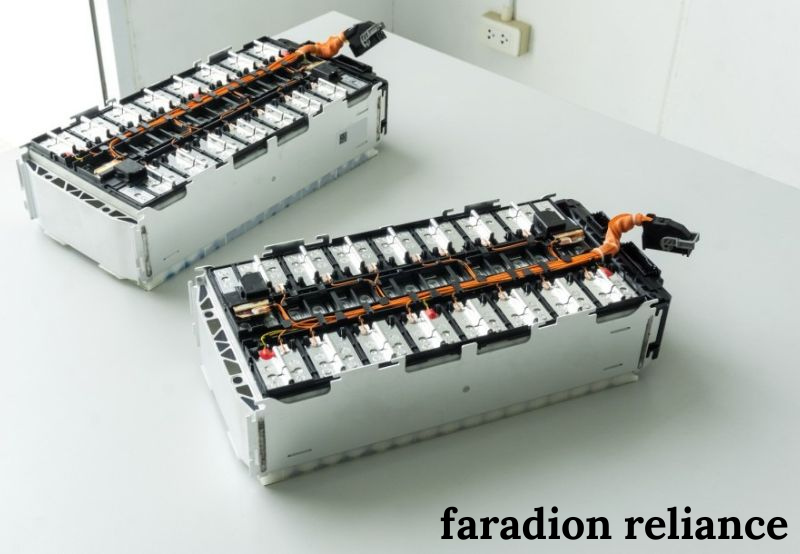
Faradion Reliance batteries are best suited for applications where reliability, safety, and cost matter most. These include renewable energy storage systems for solar and wind power, grid-level energy balancing, and backup power solutions.
They are also well-suited for electric scooters, low-speed electric vehicles, and industrial energy storage. Reliance plans to integrate these batteries into India’s expanding clean energy and electric mobility infrastructure, supporting both urban and rural energy needs.
Faradion Reliance and India’s Energy Future
India’s rapid growth in renewable energy has created a strong demand for efficient and affordable energy storage. Sodium-ion batteries provide a practical solution by reducing reliance on imported lithium and strengthening domestic manufacturing.
Faradion Reliance supports energy independence, aligns with the “Make in India” initiative, lowers energy storage costs, and accelerates renewable energy adoption. This positions India as a potential global leader in alternative battery technologies.
Company Profile Details (Professional Clarification)
Since Faradion Reliance is a corporate technology entity, personal attributes such as height or physical appearance do not apply.
Age: Faradion Limited was founded in 2011, giving the company over a decade of industry experience.
Family: The company operates as part of the Reliance Industries corporate group rather than a family structure.
Net Worth: While exact figures are not publicly disclosed, the acquisition value was reported at approximately £100 million, highlighting the technology’s strategic importance.
Leadership: Faradion continues to operate with its experienced scientific and engineering leadership under Reliance’s strategic guidance.
Social Media and Online Presence
Faradion maintains a professional online presence focused on technology development and corporate updates. The company is active through its official website and LinkedIn profile, while Reliance Industries provides regular updates through investor communications and media releases.
Challenges and Market Competition
Although sodium-ion technology offers many advantages, it still faces challenges such as lower energy density compared to high-end lithium batteries and limited use in long-range electric vehicles. Scaling production to meet global demand is another ongoing challenge.
However, Reliance’s financial strength, manufacturing experience, and infrastructure significantly reduce these risks and accelerate commercialization.
Future Outlook of Faradion Reliance
The future of Faradion Reliance appears promising. With Reliance’s planned green energy giga-complex, sodium-ion batteries are expected to move quickly from pilot projects to large-scale production.
Experts believe this technology will complement lithium-ion batteries rather than replace them, dominate stationary energy storage markets, and enable affordable access to clean energy worldwide.
Final Thoughts
Faradion Reliance represents a powerful step forward in the global clean energy transition. By combining Faradion’s innovative sodium-ion technology with Reliance Industries’ scale and vision, this partnership creates a strong foundation for sustainable energy solutions.
This initiative is not just about batteries. It is about energy security, environmental responsibility, and long-term technological independence. As renewable energy adoption continues to grow, Faradion Reliance stands out as a model for how smart investments can shape the future.
FAQs
Q: What does Faradion Reliance mean?
A: Faradion Reliance refers to Faradion Limited operating under the ownership of Reliance New Energy, focusing on sodium-ion battery technology.
Q: Why did Reliance acquire Faradion?
A: Reliance acquired Faradion to secure advanced battery technology and support affordable, safe, and sustainable energy storage solutions.
Q: What makes Faradion’s batteries different?
A: Faradion batteries use sodium instead of lithium, making them safer, lower-cost, and more environmentally friendly.
Q: Are Faradion Reliance batteries used in electric vehicles?
A: Yes, they are suitable for electric scooters, low-speed EVs, and stationary energy storage applications.
Q: Does Faradion Reliance replace lithium-ion batteries?
A: No, it complements lithium-ion batteries by serving applications where cost, safety, and sustainability are priorities.
